
Middle East Update

Following significant developments in the Middle East over the weekend, we wanted to provide you with a clear, succinct update on what has happened, how markets have reacted in the potentially early stages of this conflict and what this means for your portfolio.
1. What has happened
US–Israel strikes inside Iran have resulted in leadership losses at the highest levels, with confirmed fatalities among senior Iranian officials. Iran has retaliated with missile and drone strikes across the region targeting Israel and US‑linked assets. This marks one of the most destabilising escalations in years.
Humanitarian situation deteriorating - reports of civilian casualties in Tehran, Minab and elsewhere underscore that while markets are reacting to supply‑chain risks, the human impact is both deep and tragic.
Strait of Hormuz disruption intensified, not only from military risk but from insurance‑market withdrawal, which is now the primary bottleneck in tanker movements. One analyst described the Strait as “the English Channel - but very shallow”: a narrow choke point through which ~20% of global oil and major LNG shipments normally pass. Once insurers step back, ships simply cannot sail.
2. How markets have reacted
Energy markets:
Brent crude +7–13%, trading in the $78–82 range as Europe opened.
In early Asian and European trading, brief spikes took Brent toward $82–$85, with some markets modelling $100+ in prolonged disruption scenarios.
Safe‑haven flows:
Gold +1–2%, touching a one‑month high as investors move into defensive assets.
USD and Swiss franc stronger, reflecting classic risk‑off dynamics.
Equities:
European markets opened ~1.8% lower, with:
Energy and defence stocks sharply higher,
Airlines, travel, and consumer‑fuel‑sensitive sectors notably weaker.
Shipping & insurance:
War‑risk insurance premia in the Gulf have risen 25–50% overnight, with some insurers cancelling policies altogether - the single biggest constraint on maritime flows right now.
3. What this means for you portfolio
Your portfolio is managed with a combination of Growth, Defensive and Diversifying assets in varying amounts depending on your personal requirements for investment risk. Therefore, you are already positioned with multi‑asset diversification.
The managers we have engaged to make calls on your behalf are watching events closely but have already factored in events such as we are seeing now. Your advisers will have been talking to you about the advantage of not having all eggs in one basket, i.e. diversification. It is in times like these that diversification comes to investors’ aid, limiting damage to portfolios and allowing the potential for recovery.
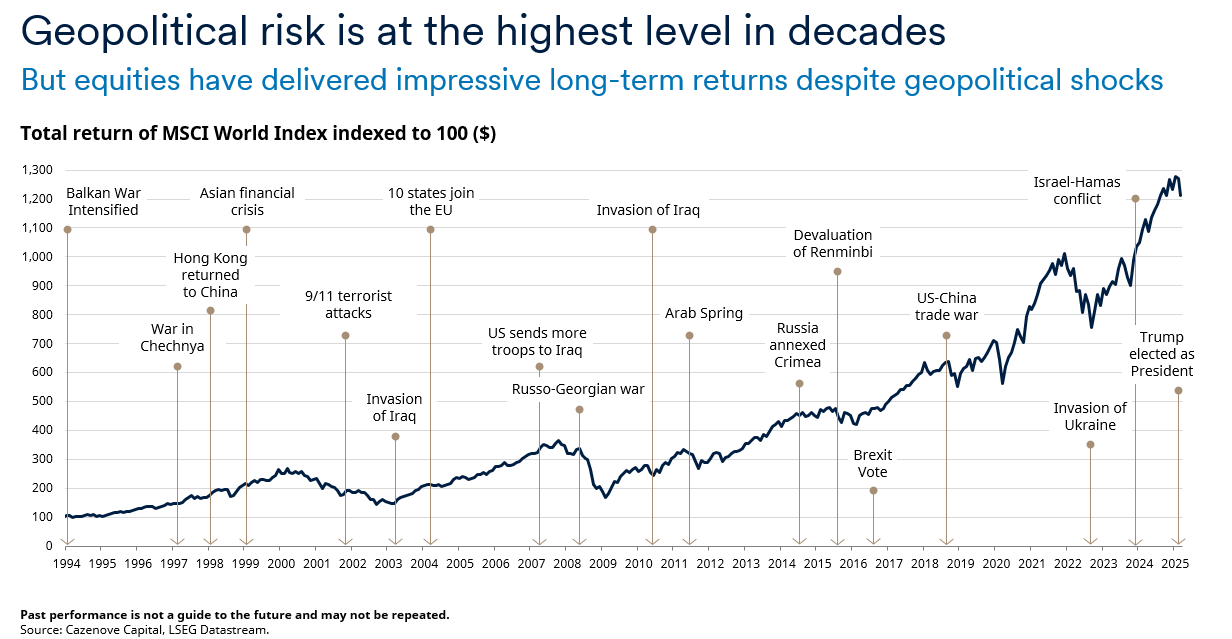
Finally, it is worth bearing in mind how conflict has had impacts on markets in the past. Although the past is no guide to future prospects, historically the markets have continued to deliver strong returns despite geopolitical shocks. The chart below shows various geopolitical events on a timeline, with the combined performance of global equity markets.
If you have any questions, please contact your Prosperis adviser at advice@prosperis.co.uk or 01423 223640.